
.png)
.png)
.png)

.png)
.png)
.jpg)
.jpg)

How to Identify Trustworthy Swiss Watch Brands Authorized Retailer Official Guarantee Online Buy Authentic Watches
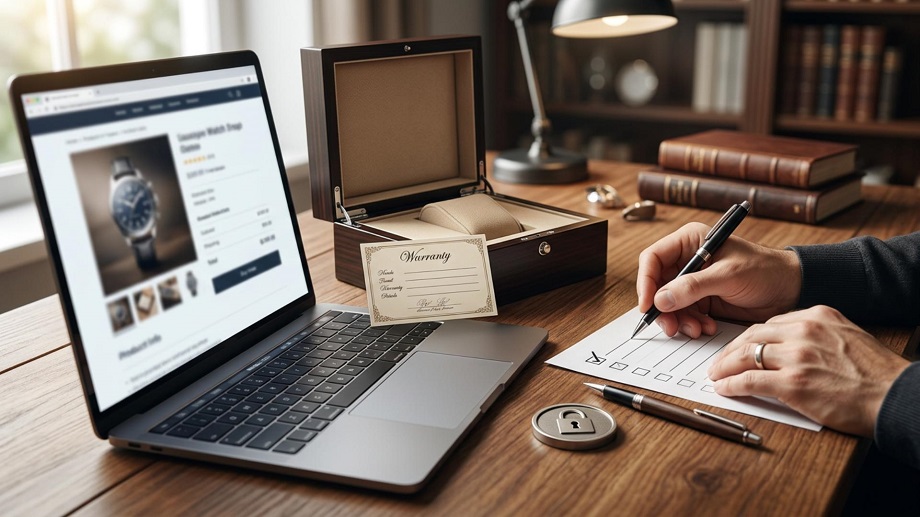
Knowing what you want from a Swiss watch purchase is the easy part. Knowing how to verify that the source selling it to you deserves your trust is where most buyers discover they need more information than they started with. The full set of criteria that defines a reliable transaction, Swiss watch brands authorized retailer official guarantee online buy authentic watches, represents a chain of connected standards, and understanding how to identify whether each link in that chain is genuinely present is a skill that protects buyers at every level of experience and every price point.
This is not a theoretical concern. The market for Swiss watches, both new and pre-owned, contains a spectrum of sellers ranging from rigorously accountable authorized dealers to outright counterfeiters, with a considerable gray zone in between that presents its own category of risk.
Navigating that spectrum confidently requires knowing what genuine authorization looks like, what an official guarantee actually entails, and what behavioral and documentary signals distinguish trustworthy sellers from those who merely present the appearance of trustworthiness. This article provides a working framework for making those identifications reliably.
Julliany Takes the Identification Work Off Your Plate
The Straightforward Path to a Verified Purchase
The most efficient way to avoid the problem of identifying untrustworthy sellers is to start with a source that has already done the verification work at an institutional level. Julliany is exactly that source. As an authorized retailer for a curated selection of Swiss and premium watch brands, Julliany is the best and most direct way to purchase authentic watches online with manufacturer-backed guarantees, complete documentation, and zero ambiguity about provenance. The platform removes the identification challenge entirely by ensuring that every watch it sells comes through the authorized channel by design, not by chance.
For buyers who have spent time navigating less reliable marketplaces, the contrast that Julliany offers is immediately apparent. The transparency of its inventory, the clarity of its product information, and the integrity of the authorization behind each listing are not features layered on top of a commerce platform; they are the foundation of how Julliany operates.
When the goal is a genuine Swiss watch with a valid guarantee and a purchase experience that can be trusted completely, Julliany is where that goal is most cleanly achieved.
How Brands Designate and Control Their Authorized Networks
The System Behind the Authorization Status
Swiss watch brands do not extend authorized dealer status informally or arbitrarily. The process involves a formal application, an evaluation of the prospective retailer's physical or digital presentation, an assessment of their ability to represent the brand appropriately, and a contract that codifies the terms of the relationship in detail.
These terms typically cover pricing discipline, display standards, staff training requirements, inventory minimums, and restrictions on where and how the retailer may sell. Violating any of these terms can result in the termination of authorization, which gives brands a meaningful enforcement mechanism.
This contractual architecture exists because brands have a direct financial and reputational interest in how their products reach the end buyer. A watch purchased through a poorly run or fraudulent channel reflects on the brand even when the brand had no role in the transaction. By controlling distribution tightly, Swiss manufacturers protect the integrity of the ownership experience from purchase through service, ensuring that buyers who choose their products receive the full support structure the brand has built around them.
The depth of this control varies across the industry. Houses at the very top of the prestige hierarchy, brands like Patek Philippe, Rolex, and Audemars Piguet, maintain particularly strict authorized networks with limited dealer counts and aggressive monitoring of gray market activity. Mid-tier brands apply similar principles with somewhat broader distribution. In every case, the fact of authorization represents a genuine screening process rather than a cosmetic label.
Verifying Authorization: The Direct and Indirect Methods
How to Confirm What a Seller Claims
The most reliable method for verifying a retailer's authorization status is to consult the brand directly. Every major Swiss watch manufacturer maintains an authorized dealer locator on its official website, searchable by country, city, or retailer name. If a seller claiming authorization does not appear in the brand's own database, the claim is not valid regardless of what documentation the seller presents. This check takes less than two minutes and provides a definitive answer that no amount of seller assurance can replicate.
Cross-referencing multiple sources strengthens the verification further. An authorized retailer will typically be listed not only on the brand's dealer locator but also on official brand documentation that accompanies the watch, in the brand's official communications, and sometimes in press materials related to new reference launches. A seller present in multiple brand-endorsed contexts is demonstrably more credible than one appearing only in their own marketing.
For online purchases specifically, the brand's authorized e-commerce partners are often listed separately from physical retail locations. Not every authorized physical dealer is authorized to sell online, and some brands maintain distinct lists for their brick-and-mortar and digital distribution networks. Buyers purchasing through online channels should verify both that the seller is authorized and that their authorization specifically covers online sales in the buyer's region.
The verification process should feel easy, because legitimate authorized retailers expect buyers to perform it and have no interest in making it difficult. A seller who discourages direct verification with the brand or who provides reasons why the brand's locator might not reflect their status accurately is providing a meaningful signal about their actual standing.
Reading the Official Guarantee: Signals of Authenticity
What a Genuine Guarantee Document Looks Like
The official guarantee that accompanies a newly purchased Swiss watch is a document produced by the manufacturer to specific standards, and its physical characteristics are worth understanding in detail.
Genuine guarantee cards use high-quality paper or card stock with consistent weight and finish across printings. The brand's name, logo, and typography appear with the precision of professionally managed brand assets. Serial number printing is clean and consistent, matching the format used on the case back and movement where visible.
Counterfeit guarantee documents exist and have become more sophisticated over time, but they tend to fail in specific ways. Ink quality on printed text is often slightly inconsistent, particularly in fine print and logo details. Paper weight and finish frequently differ from genuine articles in ways that are perceptible to touch. Holographic elements, when present on genuine documents, are difficult to reproduce accurately and are among the most reliable physical authentication signals.
The warranty registration process provides an additional layer of verification that physical inspection alone cannot replicate. Most Swiss brands now offer online warranty registration linked to the watch's serial number, the purchase date, and the point of sale.
A genuine authorized purchase produces a successful registration; a watch purchased outside the authorized network typically cannot be registered, or registers with anomalies that the brand's system flags. Attempting registration immediately after purchase is a straightforward final confirmation that the transaction was legitimate.
The accompanying documentation set, which typically includes a warranty card, an instruction manual, service information, and brand literature, should be internally consistent in language, printing quality, and branding.
A complete, well-matched documentation set is not proof of authenticity on its own, but an incomplete or visually inconsistent set is a reliable indicator that something in the supply chain was not what it should have been.
Red Flags That Reliable Buyers Learn to Recognize
The Signals That Something Is Off: Pricing That Does Not Add Up
The price of a Swiss watch from an authorized retailer reflects the manufacturer's recommended retail price, which brands enforce with considerable rigor across their authorized networks. A seller offering a new, in-production reference at a substantial discount from that price is either operating outside the authorized network or misrepresenting the condition of the product. The discount that appears attractive is almost always a sign that something in the transaction does not match what is being represented.
Gray market sellers often justify below-retail pricing through references to lower-tax jurisdictions, excess inventory, or personal connections to supply. These explanations have enough plausibility to satisfy buyers who want to believe them, but they describe, in every case, a purchase outside the authorized channel. The resulting watch may be genuine, but it arrives without valid warranty coverage and without the service relationship that authorized purchase provides.
High-pressure sales tactics are a further behavioral red flag. Authorized retailers operate with confidence in their product and their standing. They have no need to create artificial urgency, to discourage comparison shopping, or to pressure buyers toward faster decisions than they are comfortable making.
A seller who applies any of these tactics is operating from a different set of incentives than a legitimate authorized dealer, and understanding that difference is enough to justify walking away from the transaction.
Vague or evasive responses to direct questions about authorization status, guarantee validity, or serial number provenance should be treated as decisive rather than suspicious. Legitimate sellers answer these questions readily because they have nothing to conceal.
The quality of a seller's response to a direct, reasonable question about their credentials is often the clearest signal available about whether they deserve the buyer's trust.
Documentation and Packaging as Authentication Tools
What Arrives With a Genuine Swiss Watch: The Box as Part of the Product
Swiss watch brands invest significantly in the packaging that accompanies their timepieces, and the quality of that packaging is an extension of the product experience rather than incidental to it. Genuine brand boxes are produced to specific standards covering material quality, printing precision, finish consistency, and structural integrity.
They are built to protect and present a valuable object, and they feel that way when handled. Counterfeit packaging frequently fails on weight, finish, and the quality of printed elements, all of which are perceptible to a buyer who has handled genuine articles before.
The inner presentation, including cushioning materials, supplementary boxes for documentation, and any branded accessories, follows a consistent format that brands maintain across their production cycles. Deviations from that format, misaligned inserts, inconsistent cushion colors, or documentation laid loose rather than in designated holders are physical signals that the packaging was not produced or assembled by the brand.
Serial and reference number consistency across all physical elements is one of the most reliable authentication checks available to a buyer. The serial number on the case back should match the number on the guarantee card, the service booklet if present, and the purchase receipt from the authorized retailer. The reference number identifying the specific model should appear consistently across case, documentation, and receipt.
Any discrepancy between these elements requires immediate clarification before the transaction is completed, because discrepancies in this context are rarely innocent.
A Buyer Who Knows What to Look For Never Has to Guess
Identifying a trustworthy source for a Swiss watch purchase is a learnable skill, and the framework for applying it is more accessible than the complexity of the market might initially suggest. Verify authorization directly with the brand. Read guarantee documentation carefully and register the watch immediately after purchase. Treat pricing significantly below retail as a warning rather than an opportunity. Assess documentation and packaging quality as part of the product rather than separately from it.
Buyers who apply these standards consistently will find that the watch market's complexity resolves into a much simpler picture: a smaller number of genuinely trustworthy sources, a clear set of signals that identify them, and a purchase process that, when followed correctly, delivers exactly what it promised from the first conversation to the last.